
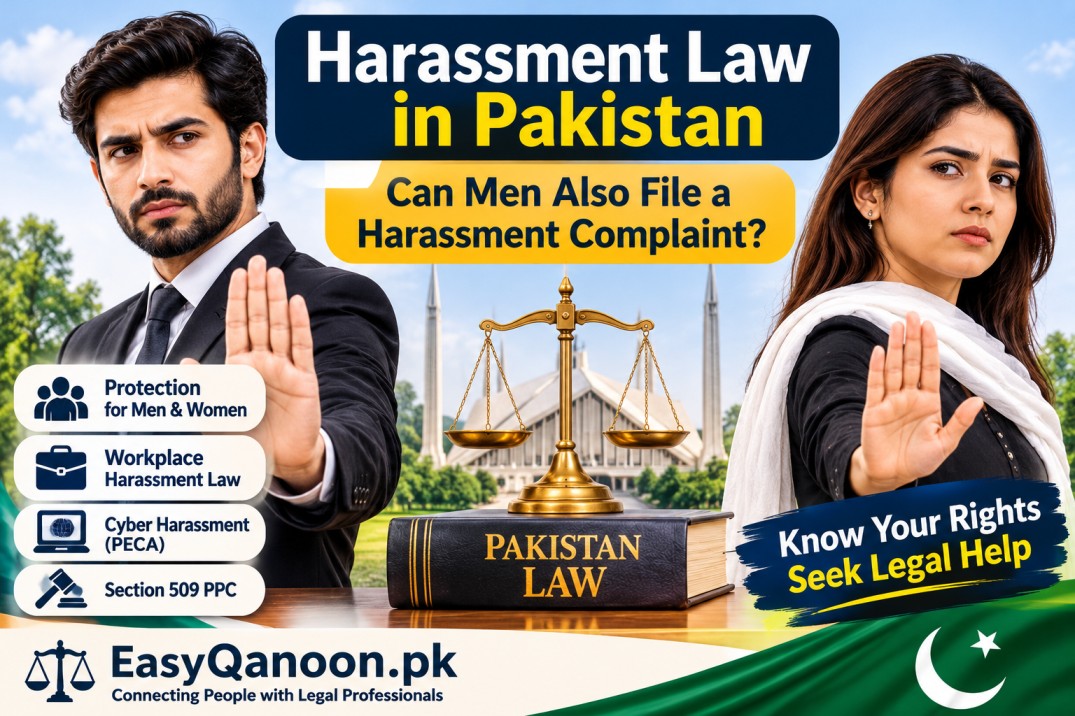
# Harassment Law in Pakistan: Can Men Also File a Harassment Complaint?
**Category:** Laws of Pakistan / Legal Awareness
Harassment is a serious legal and social issue in Pakistan. It may occur at workplaces, educational institutions, public places, homes and through social media or other digital platforms. Many people believe that harassment laws in Pakistan are exclusively designed to protect women. However, this is not entirely correct.
Under the Protection against Harassment of Women at the Workplace Act, 2010, as amended in 2022, the definition of a complainant was changed to include "any person". Consequently, men can also file complaints under the workplace harassment law if the conduct falls within the statutory definition of harassment.
This article explains the laws relating to harassment in Pakistan, the rights of male and female victims, the relevant legal provisions and the procedure for filing a complaint.
## 1. Is Harassment Law in Pakistan Only for Women?
No. Harassment laws in Pakistan are not exclusively applicable to women.
The Protection against Harassment of Women at the Workplace Act, 2010 was originally enacted to provide protection against harassment at workplaces. However, the Protection against Harassment of Women at the Workplace (Amendment) Act, 2022 made important changes to its scope and definitions.
Through the 2022 amendment:
- The definition of "complainant" was changed to include any person.
- The definition of employee was expanded to cover contractual, temporary, part-time, freelance and gig workers, interns, trainees, students and other specified categories.
- The definition of harassment was expanded to include certain forms of stalking, cyberstalking, sexual conduct and gender-based discrimination.
- The definition of workplace was expanded to include various professional and work-related settings outside traditional offices.
Therefore, a male employee or other covered person can also approach the appropriate forum if subjected to conduct falling within the Act.
## 2. Can a Man File a Workplace Harassment Complaint in Pakistan?
Yes. A man can file a workplace harassment complaint under the amended 2010 Act.
For example, a male employee may have a legal remedy where:
- A supervisor makes unwelcome sexual advances.
- An employer demands sexual favours in exchange for employment benefits or promotion.
- A person repeatedly engages in unwelcome sexual conduct at the workplace.
- An employee is subjected to gender-based discrimination covered by the Act.
- An employee is punished or disadvantaged for refusing unwelcome sexual demands.
The law does not restrict the complainant to women. The conduct must, however, satisfy the statutory definition of harassment.
## 3. What Is Considered Harassment Under Pakistani Law?
Under the amended workplace harassment law, harassment includes certain forms of unwelcome sexual advances, requests for sexual favours, stalking, cyberstalking, verbal or written communication, visual conduct and physical conduct of a sexual nature.
It also includes gender-based discrimination, whether or not it is sexual in nature, where the statutory requirements are met.
Examples may include:
- Unwelcome sexual comments or advances.
- Repeated sexually offensive messages.
- Unwanted physical conduct of a sexual nature.
- Threatening employment consequences for refusing sexual demands.
- Retaliation against an employee for refusing such conduct.
- Gender-based discriminatory behaviour creating the type of hostile or offensive environment covered by the Act.
However, every disagreement, unpleasant interaction, workplace dispute or personal conflict does not automatically constitute legal harassment. The facts and statutory requirements must be examined.
## 4. Important Laws Relating to Harassment in Pakistan
Different laws may apply depending on the nature and circumstances of the harassment.
### A. Protection against Harassment of Women at the Workplace Act, 2010, as amended in 2022
This is the principal special law dealing with workplace harassment.
The 2022 amendment expanded the definition of complainant to include any person and broadened the definitions of employee, employer, workplace and harassment.
The law provides a mechanism for complaints through an organisation's Inquiry Committee and the relevant Ombudsperson.
### B. Section 509 of the Pakistan Penal Code, 1860
Section 509 PPC deals with insulting the modesty of a woman and causing sexual harassment.
It contains two relevant aspects:
1. The first part concerns words, sounds, gestures, objects or intrusion upon the privacy of a woman with the intention of insulting her modesty.
2. The second part covers sexual advances, demands for sexual favours and specified verbal, non-verbal or physical conduct of a sexual nature intended to annoy, insult, intimidate or threaten another person, including conduct connected with employment and the creation of a hostile or offensive working environment.
The second part is not confined to female victims. It refers to the other person and can therefore apply to male victims as well, subject to proof of the required legal ingredients.
The punishment under section 509 PPC may extend to imprisonment for three years, a fine of up to Rs. 500,000, or both.
### C. Prevention of Electronic Crimes Act, 2016 (PECA)
Online harassment may also attract provisions of PECA, depending on the nature of the conduct.
Section 24 deals with cyberstalking. It covers specified conduct carried out through the internet, websites, electronic communications or other similar means with the intention to coerce, intimidate or harass any person.
Examples include:
- Repeatedly contacting a person despite a clear indication that such contact is unwanted.
- Monitoring another person's electronic communications.
- Watching or spying on a person in a manner causing fear, serious alarm or distress.
- Taking a photograph or making a video of a person and displaying or distributing it without consent in a manner that causes harm.
Section 24 is applicable irrespective of whether the victim is male or female.
The punishment under section 24 may extend to three years' imprisonment, a fine of up to Rs. 1 million, or both. Where the victim is a minor, the law provides enhanced punishment.
Other provisions of PECA may also be relevant depending on the particular online conduct.
### D. Other Criminal Law Remedies
Depending on the facts, conduct involving threats, intimidation, assault, wrongful restraint, blackmail or defamation may attract other provisions of the Pakistan Penal Code or other applicable laws.
The appropriate legal provision depends on the actual acts committed and the evidence available.
## 5. Where Can a Victim File a Harassment Complaint in Pakistan?
The appropriate forum depends on the type of harassment.
**For workplace harassment:**
1. The victim may submit a written complaint to the organisation's Inquiry Committee.
2. A complaint may also be presented to the competent Ombudsperson under the applicable law.
3. The organisation is required to establish an Inquiry Committee and implement the prescribed Code of Conduct.
For federal matters, the Federal Ombudsperson Secretariat for Protection Against Harassment (FOSPAH) provides the relevant complaint mechanism. Provincial matters may fall within the jurisdiction of the relevant provincial Ombudsperson, depending on the applicable law and territorial jurisdiction.
**For online harassment and cyberstalking:**
A victim may submit a complaint to the National Cyber Crime Investigation Agency (NCCIA), subject to its statutory jurisdiction and the applicable provisions of PECA.
**For criminal harassment or threats:**
Where the facts disclose a cognizable criminal offence, the victim may approach the police or the appropriate investigating authority for legal action under the relevant law.
## 6. What Evidence Is Required to Prove Harassment?
Evidence is important in harassment proceedings. Depending on the circumstances, relevant material may include:
- WhatsApp messages and text messages.
- Emails and social media communications.
- Audio or video recordings lawfully obtained.
- CCTV footage.
- Call records and relevant digital material.
- Witness statements.
- Employment records and official correspondence.
- Previous complaints submitted to the employer or relevant authority.
A victim should preserve original messages, electronic records, dates and other relevant information. Screenshots alone may not always be sufficient to establish the complete circumstances, so original records should be retained where possible.
## 7. What Should an Employer Do to Prevent Workplace Harassment?
Employers and organisations have important responsibilities under the workplace harassment law.
They should:
- Establish the required three-member Inquiry Committee, including at least one female member.
- Designate the competent authority.
- Display the prescribed Code of Conduct at the workplace.
- Provide an appropriate complaint mechanism.
- Deal with complaints fairly and confidentially.
- Avoid retaliation against complainants.
- Ensure that employees are informed about their rights and responsibilities.
These obligations are important for both public and private organisations falling within the Act.
## 8. Can a False Harassment Complaint Be Challenged?
Yes. A person accused of harassment is also entitled to a fair inquiry and an opportunity to present their defence.
A complaint must be assessed on its facts and supporting evidence. A mere allegation should not automatically be treated as proof of misconduct.
Where a complaint is found to be false, the legal consequences will depend on the applicable law, the evidence and whether the required elements of any separate offence or misconduct are established.
The workplace harassment law provides a procedure for inquiry and decision-making. Both complainants and accused persons should be given a fair opportunity to present their respective positions.
## 9. What Should a Person Do If They Are Being Harassed?
If you are facing harassment, consider taking the following steps:
1. Preserve messages, emails, recordings and other relevant evidence.
2. Record the dates, locations and details of incidents.
3. Identify any witnesses who may support your complaint.
4. If the matter relates to employment, consider submitting a written complaint through the appropriate workplace mechanism.
5. If the conduct involves online stalking or other cybercrime, consider approaching the NCCIA.
6. If the facts disclose a criminal offence, seek appropriate legal assistance and approach the relevant authority.
Taking timely steps can help preserve evidence and identify the correct legal remedy.
## Conclusion
Harassment laws in Pakistan provide legal protection to individuals in different circumstances. Although the workplace statute retains the title Protection against Harassment of Women at the Workplace Act, 2010, the 2022 amendment expanded the definition of complainant to include any person.
Accordingly, men as well as women may seek protection under the workplace harassment law where its statutory requirements are fulfilled. Section 509 PPC also contains a provision addressing sexual harassment of another person, while PECA provides protection against specified forms of cyberstalking regardless of gender.
Every harassment complaint must be assessed according to the applicable law, the facts and the available evidence.
**Need legal assistance?**
Visit EasyQanoon.pk to explore lawyer profiles, find legal professionals and obtain assistance regarding workplace harassment, cybercrime and other legal matters in Pakistan.